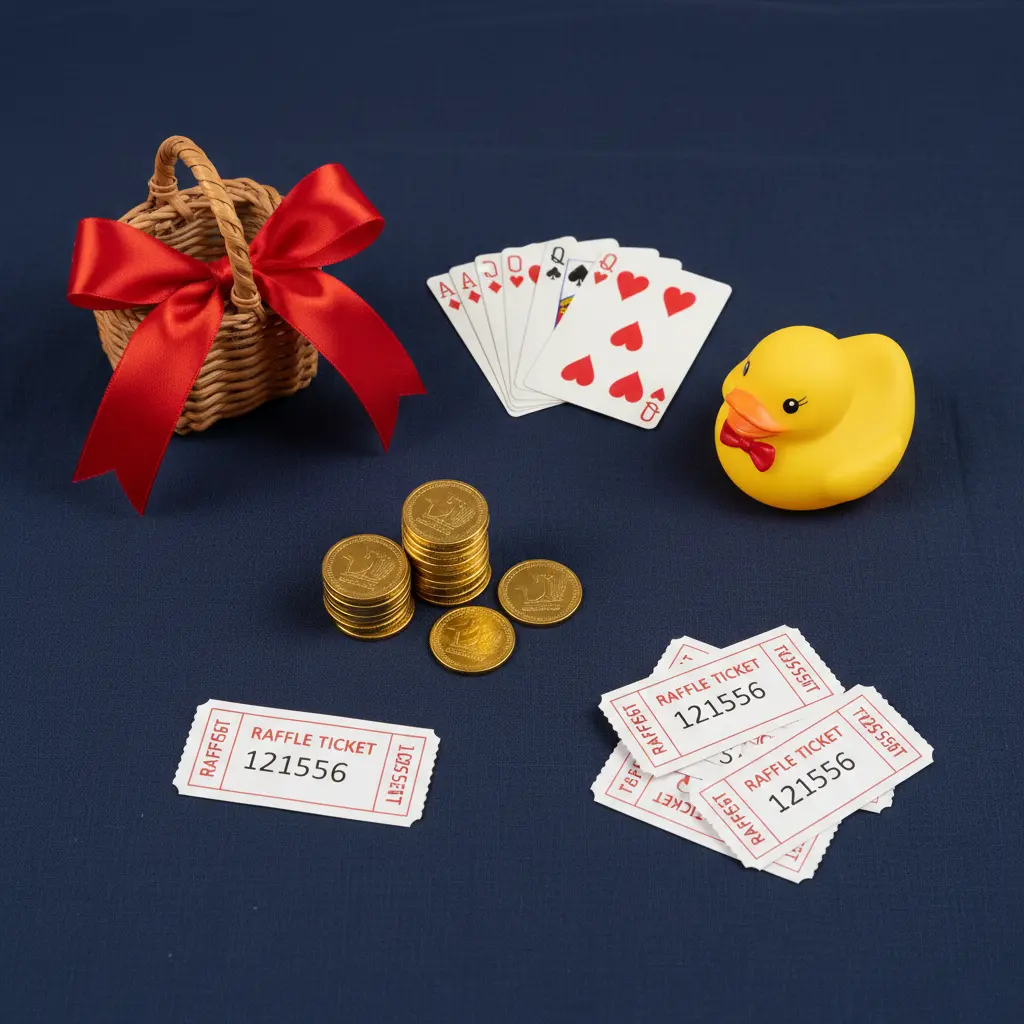
 Six Formats. One Website.
Every raffle format your nonprofit needs — honestly explained.
Most fundraising websites support one kind of raffle and call it a day. Chance2Win supports six, including four that no other nonprofit raffle website runs properly. Here's what each format actually is, who it's right for, and — just as important — who it's wrong for. We'd rather help you pick the right format than watch you struggle with the wrong one.

Online Raffle
The classic: sell tickets, draw a winner, celebrate. Simple, proven, works for almost everyone.
A traditional online raffle is what most people picture when they hear "fundraising raffle." You set a prize (or multiple prizes), set a ticket price, open ticket sales, and at the end of the campaign you draw a winner randomly from all entries. It's the format with the lowest organizational complexity, the shortest learning curve, and the widest applicability.
Online ticket sales mean every supporter gets a digital ticket with a unique number delivered by email. No physical stubs, no cash counting at a folding table, no handwriting 400 ticket numbers. Your raffle page handles it. You can still sell paper tickets in person and add those entries manually if you want the hybrid mix (more on that below).
Tiered ticket pricing is one of the most underused tools in the traditional raffle toolkit. Offering "1 ticket for $10, 3 for $25, 8 for $60" consistently outperforms single-price ticketing. The bundle math gives buyers a reason to spend more, and your average order value goes up without any change to the prize. We've seen organizations double their revenue per supporter just by adding two bundle options.
Multiple prizes work well if you want to sell more tickets at a lower price point. Instead of one $500 prize, you can offer five $100 prizes — same total prize pool, but more winners creates more excitement and more social sharing. The right structure depends on your audience and your goal.
Launching without enough lead time. A 24-hour flash raffle with a mystery prize to an audience of 200 people will raise almost nothing. Raffles need a sales window of at least 2–4 weeks, a clearly communicated prize, and an audience that's been warmed up before you ask them to buy. Passion alone doesn't sell tickets. A plan does.
Traditional raffles work beautifully for school PTOs, sports boosters, churches, and any organization with a motivated supporter base and a clear prize. If this is your first raffle, start here.
Basket Raffle
Also called tricky tray or Chinese auction. Multiple prizes, individual drawings, buyer choice. No other nonprofit raffle website runs this correctly.
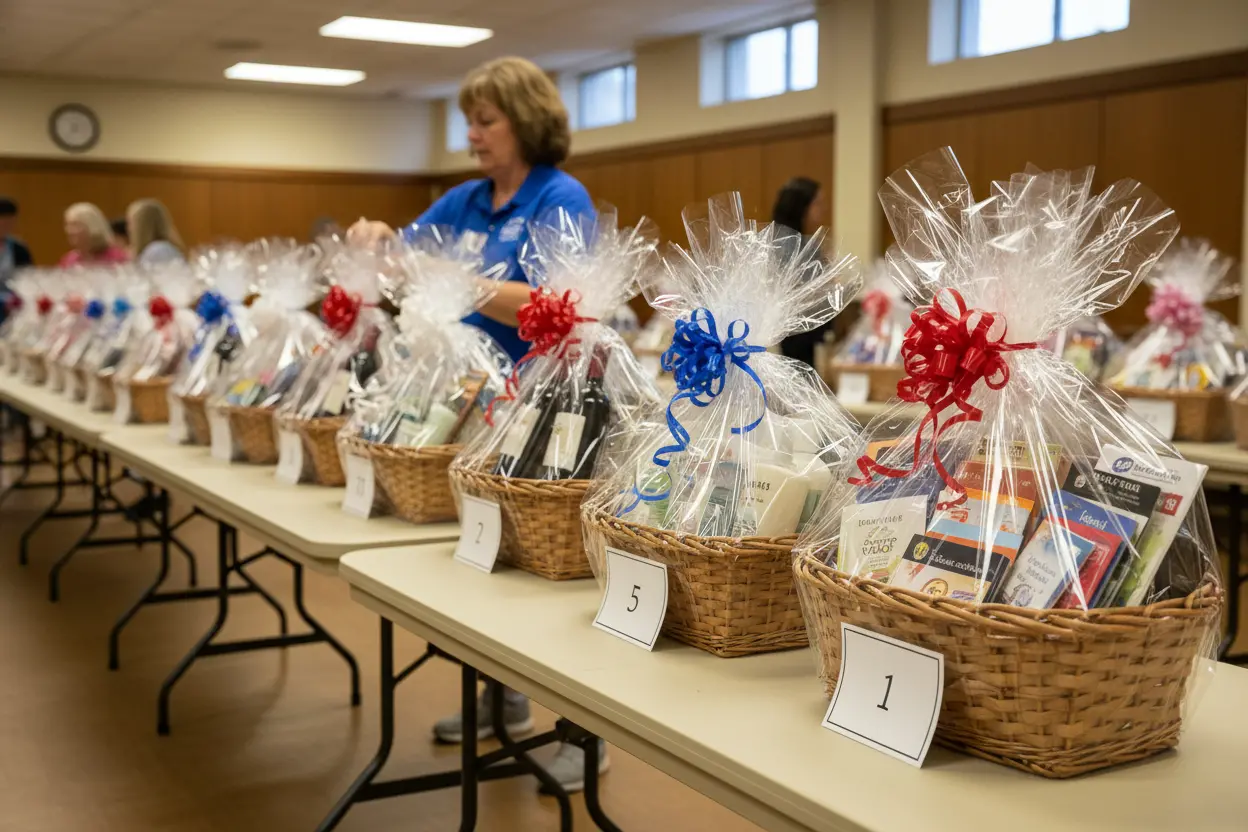
A basket raffle is fundamentally different from a traditional raffle, and the difference matters. Instead of one pool of tickets and one drawing, a basket raffle has multiple prize "baskets" — each with its own separate drawing. Buyers purchase a bundle of tickets and then allocate those tickets across whatever baskets they want. If they love the "Spa Day" basket and don't care about the "Sports Memorabilia" basket, they put all their tickets on the spa. If they want to spread their chances, they spread their tickets across multiple baskets.
The result is a raffle that feels like an event. There's browsing, strategy, anticipation, and multiple winners — not just one. Organizations that run basket raffles consistently report higher energy, more social sharing, and more repeat participation than traditional raffles because the format rewards engagement rather than passive luck.
Online, each basket becomes a digital listing with photos, descriptions, and a running ticket count. Buyers can browse before and during the event, purchase ticket bundles online (10, 25, 50 entries are common bundles), and allocate their entries digitally. Receive automatic winner notifications without anyone having to call 400 people.
The premium basket mechanic is one of the features that exists nowhere else. You can designate specific high-value baskets as "premium" — requiring 2, 3, or 5 tickets per entry rather than 1. This lets you offer a $500 basket and a $50 basket in the same raffle without the $500 basket feeling unfair. Higher-value prize? Higher entry cost. Buyers understand that intuitively, and it protects your donation economy.
The Borrowed Prize
Caller: "We have 22 baskets set up for our gala but my co-chair just told me three of the basket donors backed out."
Support: "When is the event?"
Caller: "Saturday."
Support: "Today is Thursday."
Caller: "Yes."
Support: "Did you have written commitments from the donors?"
Caller: "They said they'd do it at a meeting."
— Mary Ann "Verbal commitments at meetings are not prize inventory. Get it in writing, get it in your possession, and have a backup for every basket over $100 in value."
Basket raffles take more organizational work than traditional raffles. You need multiple prizes secured, photographed, and described. You need volunteers to manage physical baskets at in-person events. The setup in the wizard takes longer. For your first raffle, a traditional format is the smarter starting point. Once you've got one under your belt and a growing supporter base, basket raffles are where the real revenue ceiling opens up.
Basket themes that consistently sell
After watching tens of thousands of basket raffles, patterns emerge. Holiday season tree raffles (local businesses decorate trees with lottery tickets, gift cards, and themed items) are wildly popular. Movie Night baskets (TV, popcorn machine, streaming subscriptions), Spa Day baskets (robe, slippers, massage gift cards), and local experience baskets (restaurant gift cards, event tickets, service vouchers) routinely outsell generic "assorted goods" baskets by 3x or more. Buyers respond to a clear theme they can picture themselves enjoying.
Queen of Hearts
Progressive weekly jackpot raffle. Supporters select a card. If the Queen isn't drawn, the pot rolls over. We've seen these reach $300,000.
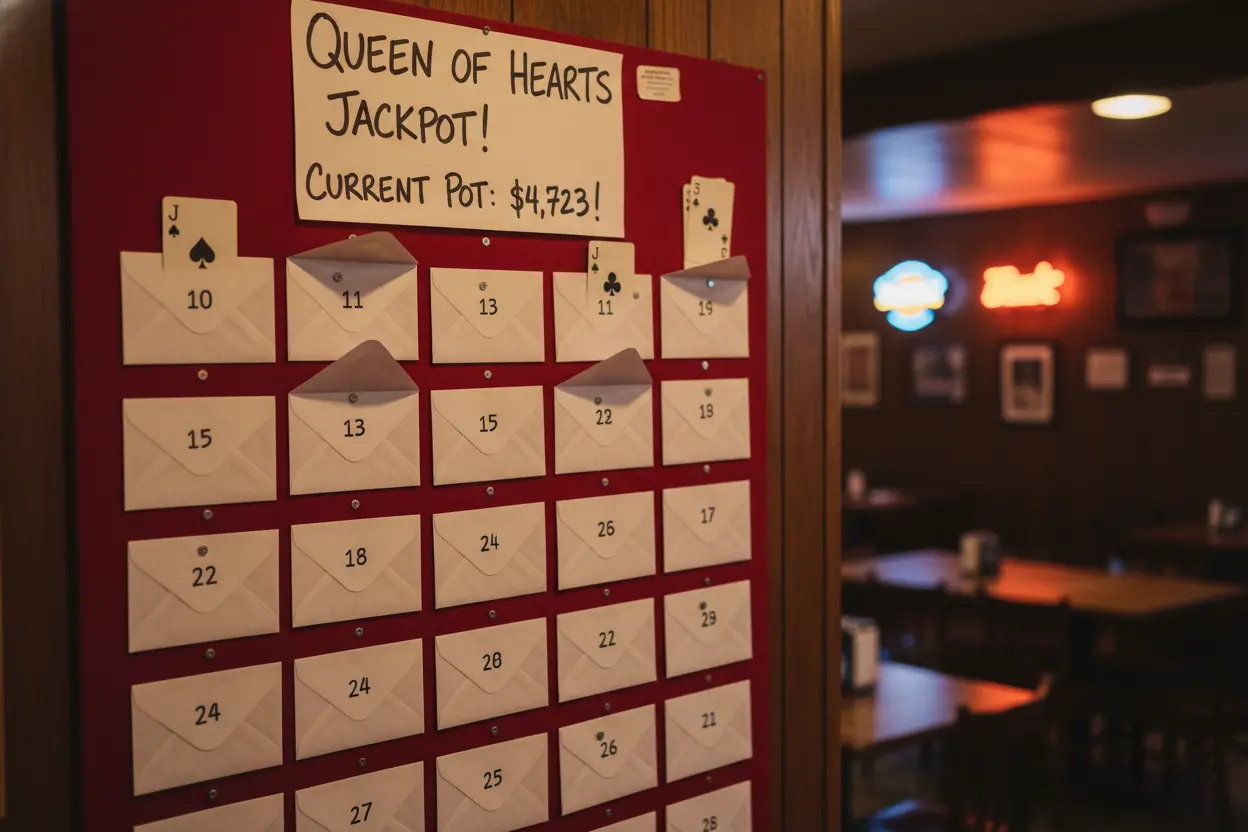
A Queen of Hearts raffle works like this: a standard deck of 54 cards (including jokers) is shuffled and placed face-down in sealed envelopes on a board. Supporters buy tickets each week. The winning ticket is drawn, and that supporter selects a card from the board. If the card revealed is the Queen of Hearts, they win a portion of the total ticket sales — typically 50%, though the split is configured by your organization. If it's not the Queen, the jackpot rolls over to next week, the ticket pool resets, and you do it again.
The mechanics create something rare in nonprofit fundraising: compounding suspense. Week one might raise $800. Week six, with a $4,000 jackpot on the board, might raise $3,000 in a single weekend. The longer the Queen evades the board, the bigger the prize and the more people want in. We've watched single Queen of Hearts campaigns raise $100,000 to $300,000 for organizations that had the audience to sustain the momentum.
Online, Chance2Win's Queen of Hearts raffle manages everything automatically: weekly digital board reveals, progressive jackpot tracking, certified random ticket draws, and winner notifications. Your team doesn't have to manually manage card assignments, run weekly drawings, or track a growing jackpot across spreadsheets. The website handles it.
The legal note that matters: Queen of Hearts is a raffle, not a gambling game — but the legal framing matters enormously. Always use the word "selecting" a card, never "betting on" or "wagering on" a card. The distinction exists in several state charitable gaming statutes, and using the wrong language can create compliance issues. This is one of the things we check during vetting.
This format is not for everyone. If your organization has fewer than several hundred consistent, engaged supporters, a Queen of Hearts raffle will fizzle rather than build. The jackpot growth depends on consistent weekly ticket sales — which depends on consistent weekly marketing to an audience that cares. Organizations with large memberships, strong weekly communication channels (newsletter, social media, club meetings), and loyal regulars are the natural fit. Veterans groups, social clubs, large PTOs, and regional nonprofits with established followings do very well. Newer organizations should run two or three traditional raffles first to build their audience before attempting Queen of Hearts.
50/50 Raffle
Half the pot goes to the winner, half to your cause. Simple mechanics, easy to sell, works great at live events.
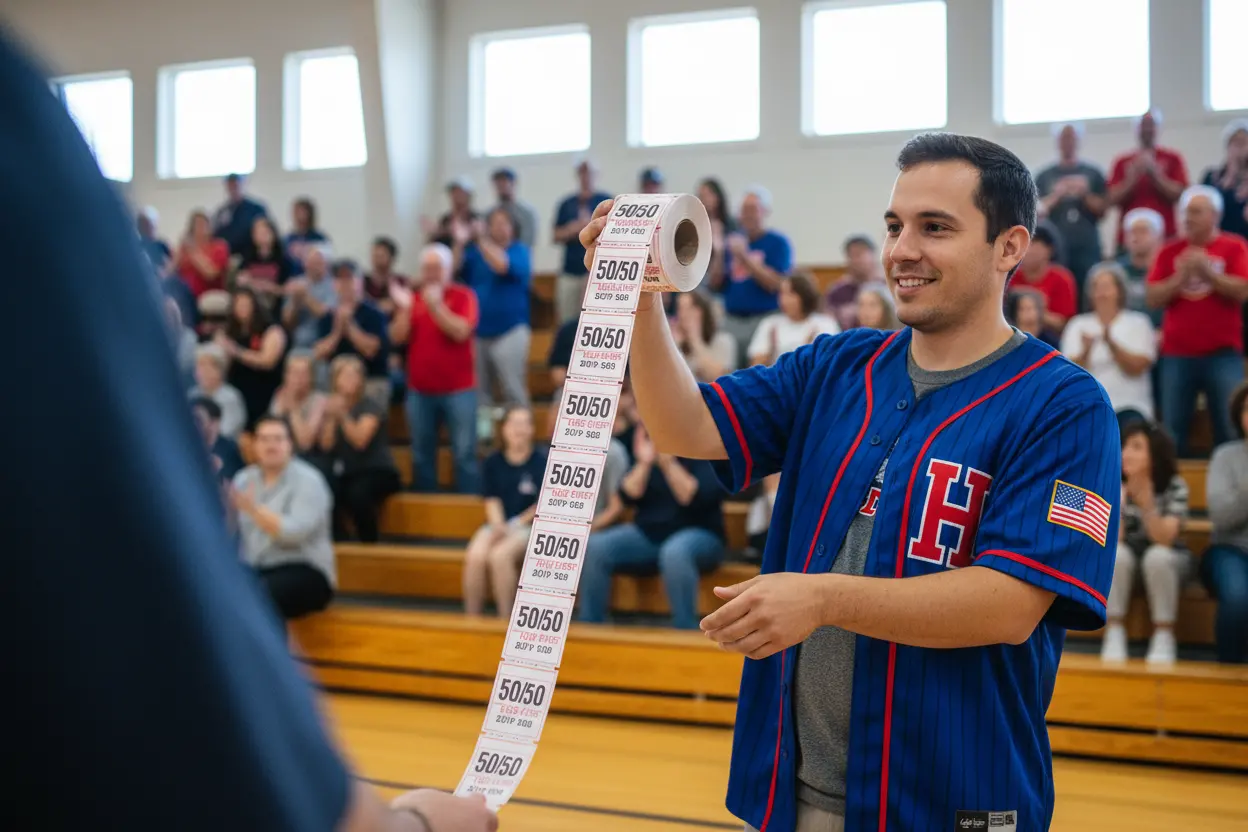
A 50/50 raffle splits the total ticket sales pool between the winning ticket holder (50%) and your organization (50%). There's no prize to source, no prize to store, no prize to ship — the "prize" is cash, generated by the raffle itself. That simplicity makes the 50/50 one of the easiest formats to launch and one of the most effective at live events where immediacy drives purchases.
At a school carnival, a sporting event, or a community dinner, a 50/50 is frictionless to explain and frictionless to enter. "Buy a ticket, you might win half the pot" takes about four seconds to communicate. The running jackpot display — visible on your raffle website and at an event screen — creates live urgency as the pot grows. People buy more tickets as the prize grows, which grows the prize, which makes more people buy tickets.
Online 50/50 raffles work well for organizations with active online communities, particularly when the jackpot target is communicated clearly in promotional materials. A "$5 ticket, pot currently $1,200 and growing" message in an email or on social media is a clean, compelling call to action.
The split doesn't have to be exactly 50/50 — your organization configures the percentage. Some organizations do 60/40 (60% to the cause), some do 40/60 if they want a bigger prize incentive to drive volume. The most common is 50/50 because it's the cleanest explanation, but you have flexibility.
Duck Race / Ball Drop
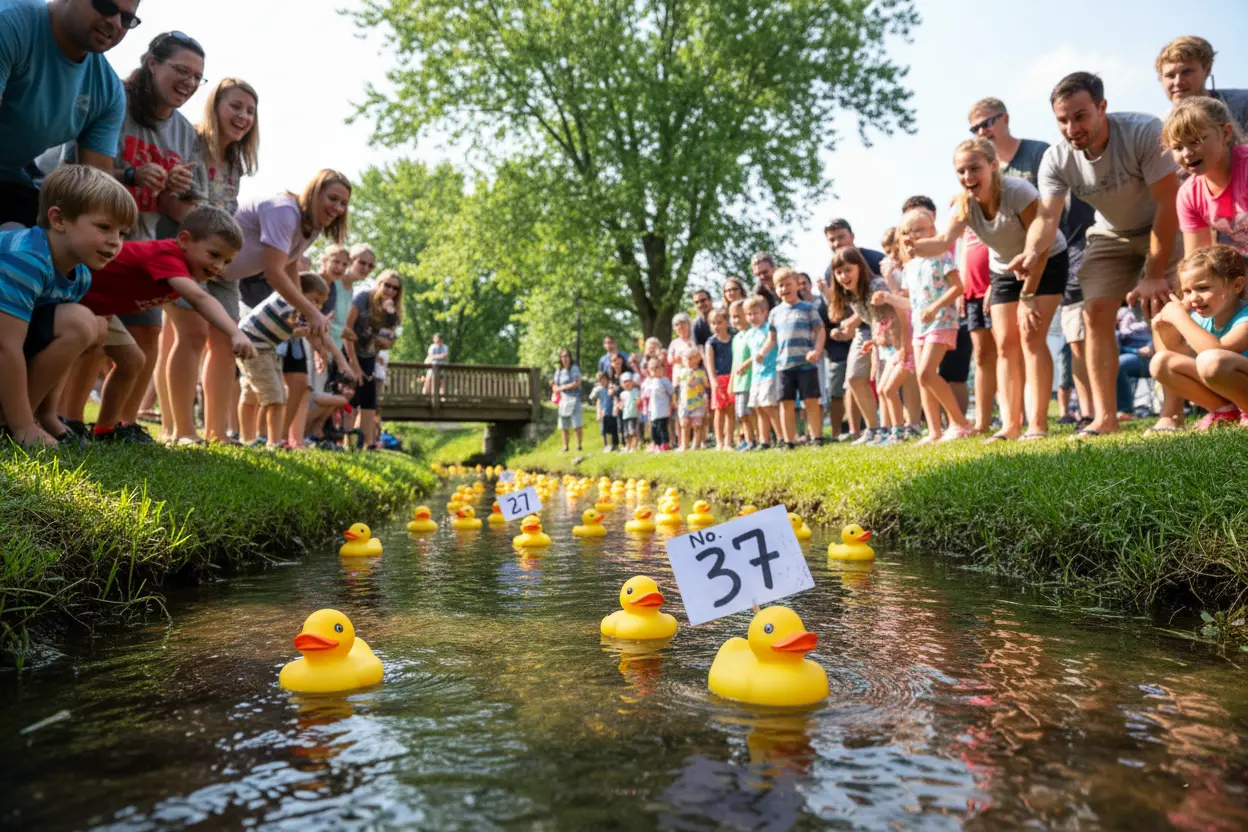
Pre-numbered tickets tied to physical ducks or golf balls. The winner is whichever duck crosses the finish line first — or whichever ball drops first. The numbering management is where this gets complicated.
Duck races and ball drops are community events with a dedicated following, particularly in smaller towns and regional nonprofits where they're annual traditions. The mechanic: sell numbered tickets online and in person, each corresponding to a physical rubber duck in a river race or a numbered golf ball in a drop. Race day or drop day, the duck or ball that finishes first wins the prize for whoever holds that ticket number.
The complication that makes this format unusable on generic raffle platforms is the numbering management. If 500 tickets are sold but 23 are refunded, you don't just have 477 tickets — you have 477 specific ticket numbers, and the physical ducks or balls at your event need to match that exact list. If ticket #47 is refunded and then duck #47 is still in the race, the duck without a valid ticket could win. That creates an impossible situation on race day.
Chance2Win handles renumbering after refunds automatically. When a ticket is refunded, it's removed from the pool and the corresponding number is flagged. Your printable roster for the physical event reflects the actual, current ticket-holder list. No competitor does this. On other platforms, you'd be managing this in a spreadsheet manually — or worse, not managing it at all and hoping nobody notices the discrepancy.
For large duck races (1,000+ ducks is not uncommon for established community events), the numbering integrity is the entire logistical backbone of the event. Getting it wrong isn't a minor inconvenience — it's a potential dispute with your winner, a question of raffle validity, and an organizational nightmare on event day when you're standing next to a creek with 1,200 rubber ducks.
Hybrid Raffle
Cash, check, and online entries in one unified drawing. The pool belongs to your organization. No other raffle website has this.
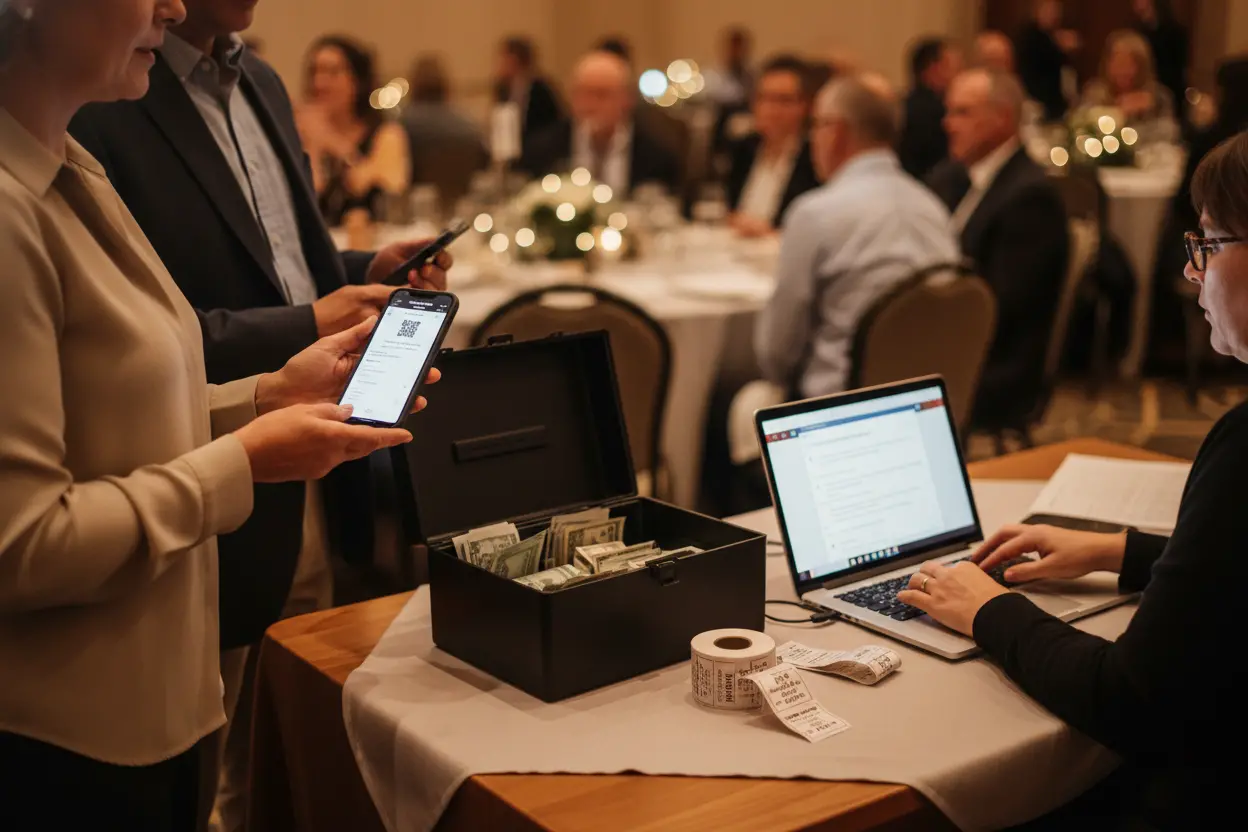
A hybrid raffle runs a unified drawing that includes both online ticket sales and manual entries for cash or check purchases made in person. Every entry, regardless of how payment was collected, goes into one drawing pool. One winner. Transparent and complete.
This matters because every in-person raffle — even one primarily sold online — will have cash buyers. The elderly supporter who doesn't have a smartphone. The neighborhood business that wants to contribute but hands over a check. The event-night walk-up who has $20 in their pocket. These buyers exist at every raffle, and most online raffle platforms have no mechanism to include them fairly in the drawing.
What competitors do instead: they call it "offline ticket tracking" and give you a spreadsheet. You're expected to manually reconcile cash sales against online sales, maintain the integrity of the pool yourself, and somehow generate a fair drawing that includes both. That's not a hybrid raffle system — it's a manual process with a digital side note.
Chance2Win's hybrid pool means the drawing pool belongs to your organization and is administered by your raffle website. Cash entry is manually recorded in the system and assigned a ticket number. That ticket number is included in the certified digital drawing alongside all online entries. There's no separate process, no spreadsheet, no reconciliation headache.
In a typical hybrid raffle, cash and check entries represent about 1.5% of total entries on average. But for some communities — particularly older demographics, rural areas, and organizations that do significant table sales at events — it can be 15%, 20%, or more. If that 20% of your entries isn't in the drawing, your raffle isn't actually your raffle.
The Abandoned Pool
Caller: "We ran our raffle online but then on the night of the event we had a bunch of people pay cash. We didn't enter them."
Support: "Why not?"
Caller: "We didn't know we could."
Support: "The drawing already happened?"
Caller: "Yes."
Support: "So you have cash from people who bought tickets that weren't included in the drawing."
Caller: "...yes."
— Mary Ann "You collected money for raffle entries you didn't enter. That's not a process problem — it's a legal problem. Manual entries must be added before the drawing closes. Not after. Not 'oops.'"
Which format is right for your organization?
Use this as a starting point. When in doubt, call us at (813) 699-9325 — we've helped organizations choose the right format thousands of times. It's a five-minute conversation.
| Format | Setup Complexity | Audience Size Needed | Prize Sourcing Required | Best Revenue Range | Exclusive to C2W |
|---|---|---|---|---|---|
| Traditional Raffle | Low | Any size | Yes (1–few prizes) | $1,000–$50,000 | ✗ |
| Basket Raffle | Medium–High | Medium+ with event | Yes (many baskets) | $5,000–$100,000+ | ★ |
| Queen of Hearts | Medium (ongoing) | Large, loyal audience | No (cash jackpot) | $20,000–$300,000+ | ★ |
| 50/50 Raffle | Low | Any size | No (cash split) | $500–$20,000 | ✗ |
| Duck Race / Ball Drop | Medium | Community event audience | Yes (physical prize) | $3,000–$50,000 | ★ |
| Hybrid Raffle | Low add-on to any format | Any (with in-person sales) | Depends on base format | Adds 5–20% to base | ★ |
★ = exclusively available on Raffle Creators / Chance2Win. Revenue ranges are illustrative based on observed campaigns, not guarantees.
Not sure which format is right? Just ask.
Call (813) 699-9325 or start your application and tell us about your organization. We'll help you pick the right format before you build anything.
Raffle and charitable gaming laws vary by state. This is not legal advice. Format availability may vary by state eligibility — we confirm during the vetting process.